Yep, it is possible! And I hope it is at the very top of your list for this summer!
Relatively speaking, it doesn’t take much, but it is a journey. So maybe it’s better said as: the summer you start your official sustainable living journey. (Admittedly, that’s a bit long for a blog title, but you get the point!)
I don’t want to get overly technical – there is no need, but I do want you to have few facts front-of-mind. Essentially, the issue with climate change – in case you didn’t fully know how to explain it – is that we are accumulating way too much CO2e (Carbon Dioxide Equivalent, which includes all greenhouse gases) in our atmosphere.
Normally, like during the pre-industrial era, greenhouse gases accumulated at a level that kept Earth just warm enough to live on. But the additional, and you may have heard this word, anthropogenic (human-created) greenhouse gases are overloading what normally cycles through the system. There is a lot more science here, but the one-liner is this: our current lifestyles are creating too much yuck in our atmosphere, and that is causing – YES, causing! – climate change.
The Power of Everyday Choices
So, what the heck can we do about it? Well, there is lots to be done, but what I want to share with you today are ideas about your own sustainable living.
Our everyday activities add up. From consumerism, to what’s on our plate, our transportation choices, and even all our little daily habits and lifestyle decisions, they all represent our carbon footprint – which is essentially an estimation of how much greenhouse gas we as individuals are responsible for.
Now, these are all estimations. There is absolutely no tool that follows you around checking your car’s exact mileage, how far you drive every day, or how many pounds of meat and cheese you eat. Instead, these numbers are population estimations. I have seen them calculated by country, by industry, and by state. But what I want to look at today is the per capita (individual) estimation:
- United States: The average per person annual emission is somewhere between 15–20 metric tons.
- Denmark & The European Union: Their numbers come in at around 5 metric tons per person.
When you see that contrast, you can see exactly where my focus is. I want us to look at closing the gap between what is possible in other countries and what we are doing in the U.S.
Don’t get me wrong, I am well aware of the structural differences – some that we cannot easily overcome on our own – like infrastructure, legislation, regulations, funding, and culture. But there is still plenty of room for us to personally close the gap between that 5 metric tons and 15–20 metric tons. So, where the heck do you begin?
Your Summer Reading List
Most of us are just at the beginning of summer vacation. Maybe you will have a bit of down-time to read a new book or two? For sure, the kids will have some time to read. So why not pick a book that helps you get started on a more sustainable way of life?
It doesn’t have to be heavy reading. I’m not suggesting that you pick up a textbook and try to get an Environmental Science degree, but how about a few informative, easy reads?
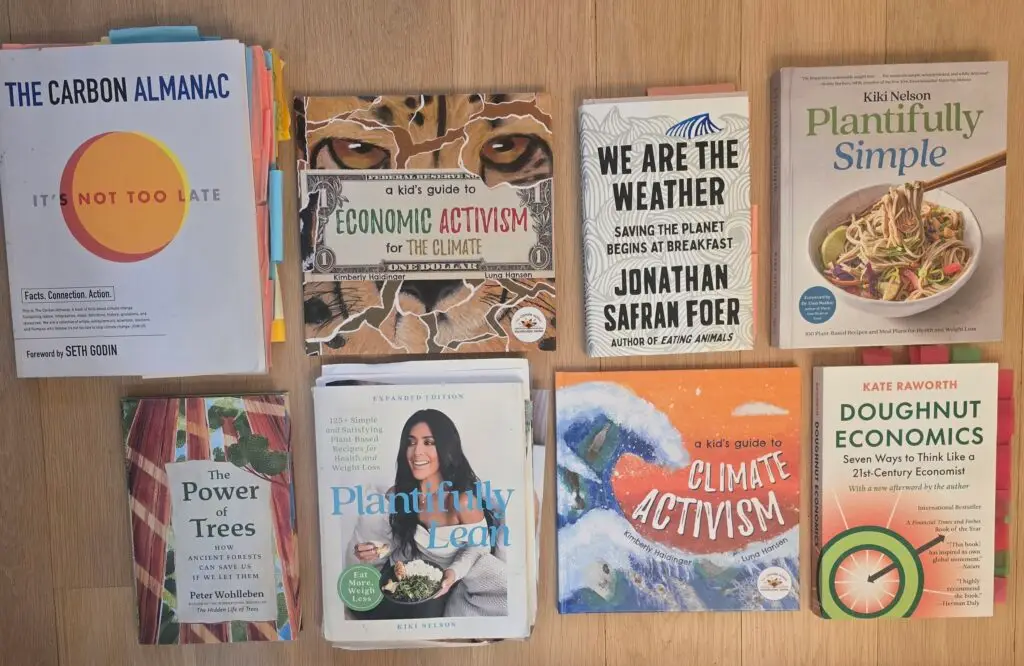
Here are my top 8 absolute favorites. (Full disclosure: the kids’ books are written by me and illustrated by my daughter! So, yeah, I am a bit biased!)
1. The Carbon Almanac
This book is cooler than cool when you are looking for the facts. It breaks down everything – like, literally everything – into bite-sized pieces. It also provides all of its sources as backup, which gives you a great place to dive deeper if you want more. If you want to learn the foundations of climate change, this is the perfect book to get started.
2. We Are the Weather
This is a great book if you are curious about how what we put on our plate affects climate change. If you think a book about climate change and food can’t be an absolute page-turner, let this one prove you wrong. Amazingly, a book that ultimately encourages you to shift your diet by just 10% to positively impact the climate, doesn’t mention a single bit about food in the first sixty pages! It is an informative, easy read packed with specific, serious facts about the world that will stick with you – and change the way you think, and eat, forever.
3. The Power of Trees
This book made me love trees in a way that I did not think was possible. I have always valued nature, but now every walk in the forest has turned into a tree-appreciation love fest. Much to the chagrin of my husband, I do now outwardly talk to trees! I congratulate them when they are thriving and encourage them when they look weak. I ask them to continue to work together. It is easily one of my favorite books of all time, but don’t read it if you aren’t ready for the consequences of becoming an un-apologetic tree lover!
4. Doughnut Economics
Maybe a bit more of a heavy read for your summer reading list, but if you want to really connect how you live and look at consumerism with the measurement of a healthy planet, this is it. If you are curious, or want a quick refresh in economics, this is the perfect book. In our “more, more, more” way of living, this book successfully provokes a different way of thinking and, ultimately, a different way of living.
5. Plantifully Lean
On my journey to finding more plant-based recipes, I bumped into Kiki Nelson. My copy of this book is literally falling apart because I have used it so much! Sections one and two of the book are about weight loss and getting started, but even if you aren’t focused on losing weight, I found a lot of insightful lifestyle information in these pages. I have made almost every recipe in this book, and it is definitely my go-to for weeknight dinners. A massive family favorite is the Sweet Potato Tacos (page 115).
6. Plantifully Simple
This is the second plant-based recipe book that I grabbed from Kiki Nelson. Plant-based eating can be so fulfilling, offering incredible variety in nutrients and flavors while satiating you in the best possible way. You just need some really good ideas to get started. Some of our favorite go-to meals from this one are the Creamy Roasted Pepper Pasta (page 165) with Roasted Red Pepper Sauce (page 213), the Falafel Cauliflower Pitas (page 120), and the Loaded Taco Sweet Potato (page 142).
7. A Kid’s Guide to Climate Activism
If you want to jumpstart your child’s vocabulary this summer, this guide is built to teach big concepts in an accessible way. From understanding “carbon sinks” to mastering “climate neutrality,” it gives kids the words they need to feel empowered, not left out. Critics have highly recommended it, noting that it completely avoids the typical doom-and-gloom approach. Instead, it directly connects personal values to practical habits like composting and eating plant-based. Backed by Luna’s cozy, friend-made artistic style, it transforms complex environmental science into an exciting, actionable adventure for young minds.
8. A Kid’s Guide to Economic Activism for the Climate
The second book in The Climate Action Vocabulary Series is an exciting introduction to economics, think ECON-101, but completely tailored for your middle-grade reader. This book takes the reader on a journey where they learn concepts like GDP, shareholder vs. stakeholder, profit and loss, infrastructure, and stranded assets. The big revelation is that the reader finally understands why businesses don’t always put people and the planet in front of profits. The great news? The reader will also learn that they hold immense power right there in their pockets – their spending dollars.
Both A Kid’s Guide to Climate Activism and A Kid’s Guide to Economic Activism for the Climate are filled with practical action ideas that young readers can jump right into, beautifully turning climate anxiety into hope-filled action.
How to Buy Your Books (because it matters too!)
These books are available everywhere you buy your books, but my personal preference is that you purchase them by walking into a local bookstore and finding them on the shelves (or ordering directly through them).
How lovely is it to walk into a shop where you can learn the names of the people helping you, while knowing that your hard-earned dollars are being spent right back in your own community?
If you can’t get out or simply prefer to order your books online, check out Bookshop.org. You can order online and support your local store at the very same time!
Your Quick Summer Cheat Sheet
Want a summary of the absolute basics you can do to begin your sustainability journey this summer?
- Read these books! They will help you develop your own list, but in the meantime, here are a few items you can do while you read …
- Get your food waste out of the trash (start composting or subscribe to a local pickup service that will do it for you).
- Eliminate single-use items wherever you can.
- Eat more plant-based meals.
- Shop local.
There! That all sounds fun and very summery, doesn’t it?!
There is so much more that we can say about this, so please feel free to reach out if you have thoughts or questions.
Happy summer reading!