How can I motivate you to put your household on a “Carbon Emissions Diet”? Think about it, almost every activity we do from driving the kids to school, to cooking dinner, to powering our home offices involves burning fossil fuels.
I know it can get confusing. We hear terms like “100% renewable energy,” “CO2 equivalent,” or “net-zero households,” and it feels like we need a PhD just to take out the trash. But here’s a secret, the technical specifics don’t actually matter right now. If we can simply agree that our daily human activities add to global carbon emissions, we have all the information we need to start. The real question is, can we take that basic agreement and turn it into a movement of “doing less”? Or, doing the same with less impact!
I’m talking about looking at our daily choices and intentionally shifting them until they develop into new, sustainable habits. Just as you would make lifestyle changes to lose weight, drink less, or exercise more, we can all shift our behaviors to emit less carbon.
Don’t believe me? I’ll give you one of the biggest and most obvious examples – one that requires zero new infrastructure, no government investment, and no high-tech gadgets. Choose plant-based meals.
Did I just say, “eat vegan?” Umm, yes, yes, I did!
Are you still there? I hope so! Bear with me for a minute, because I’m using this as a “case study” for how a simple lifestyle shift can radically lighten your carbon load.
The Stats, the Steps, and the “Gold Star”
If you are still reading, GOLD STAR! Seriously!
I’m using the “vegan example” because it’s a powerful illustration of how our personal choices and food systems impact the climate. My goal isn’t to say this is the only route to lowering your footprint; rather, eating plant-based simply helps us see that our numbers really do matter. Check out these facts:
- The Big Picture: The UN asserts that livestock is responsible for roughly 14.5% of annual global emissions (Safran Foer, p. 95). Some researchers estimate that when you account for overlooked factors, that number could be as high as 51% – more than all cars, planes, and power plants combined (Safran Foer, p. 96).
- The Beef with Beef: Producing just one pound of beef generates 30 pounds of CO2 (Network, 2022. p. 76).
- The Personal Impact: Switching to a plant-based diet can reduce an individual’s annual carbon footprint by up to 2.1 tons (United Nations).
I am hoping that I didn’t lose you on the stats! If you skimmed past them, take one more quick look because the numbers are astonishing! But here is the most important part: I am not trying to “convert” you to a plant-based diet. My goal is simply to show you that what we do – everything we do – matters. We have the space to dramatically lower our impact on climate change, and there are so many ways to do that. This isn’t a competition (NEVER!) or a place for judgment, I hate that! None of us is perfect, but it would be great if all of us could just try to emit a bit less.
I’m hoping you might be ready to do just that, like right now. Earth Day will be here in the blink of an eye, and I would love for it to be an every-day celebration instead of a once-a-year awareness day that, quite honestly, rarely results in the kind of permanent change we need.
Earth Day: A Day for Teaching (and Doing)
Earth Day is Wednesday, April 22nd. It’s important to remember that when this day was first created in the 1970s, it was designed as a “teach-in” – a day dedicated to community learning.
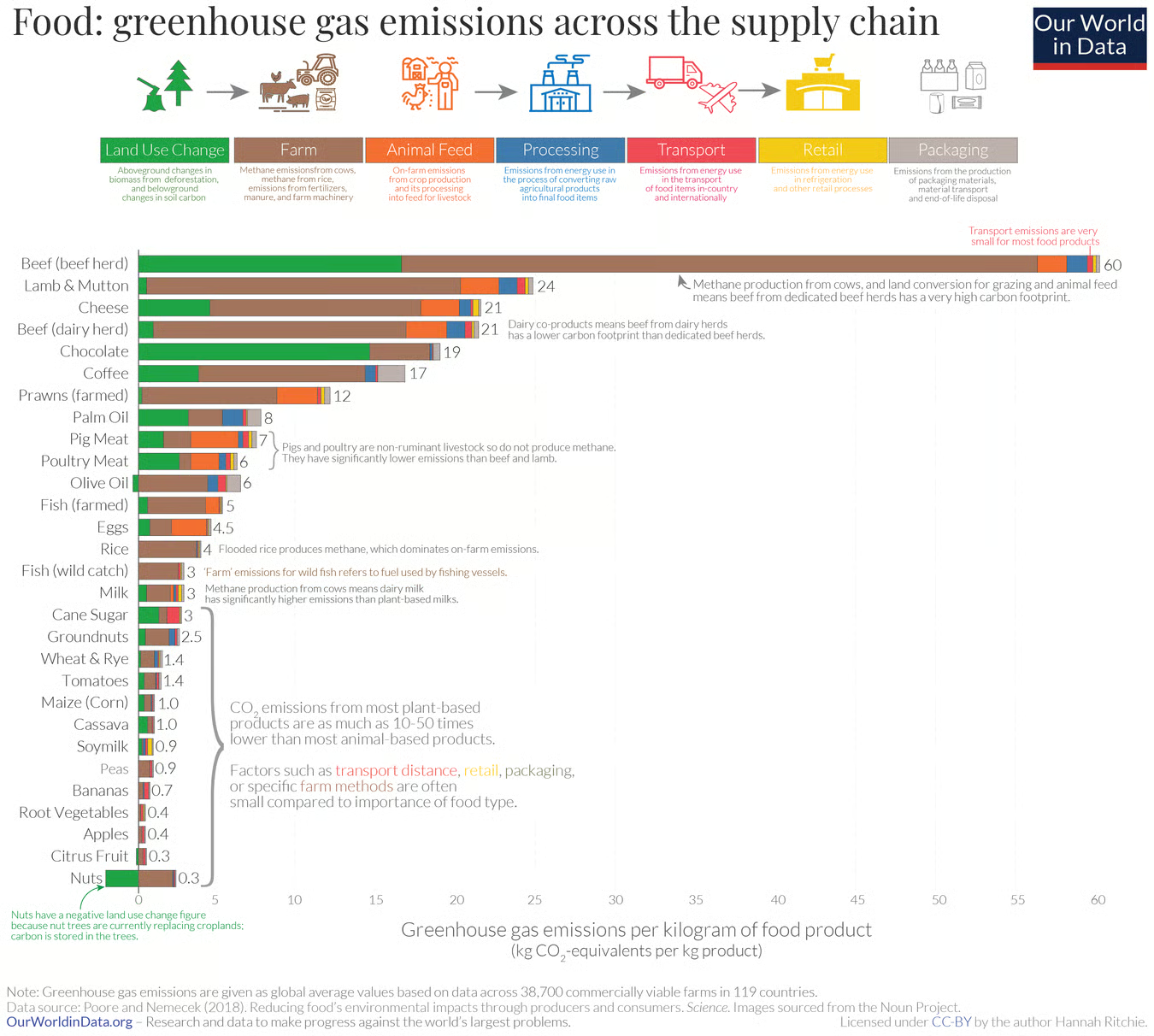
So, consider this your lesson for the day! (I’ve even included a graph below because nothing says “learning” like a good visual). In my experience, learning creates an awareness that naturally makes space for application. When it comes to the climate, any “Aha!” moment that leads to even a small amount of implementation is a massive win. That is why I want to challenge you, in honor of Earth Day’s origins, can we use April 22nd as a marked day on our calendars to learn one new concept and try one new “carbon-lowering” habit shift?
Just like a learning target in school or a fitness goal at the gym, we can schedule ourselves to adopt new knowledge and skills until they become muscle memory.
- Want to go fully plant-based? Congratulations!
- Want to try Meatless Mondays? Congratulations!
- Want to swap just one meat meal a week? Congratulations!
Every step marks progress, and every bit of learning leads us closer to a healthier planet.
Beyond the Plate: More “Diet” Tips
If changing your diet isn’t in the cards right now, don’t feel bad! There is so much more you can do. Approach these with the same “lifestyle shift” mindset:
1. Compost Your Food Waste Whether you use a device like the Mill Food Recycler (my personal favorite!), a backyard bin, or a local pickup service, getting food out of the trash is a game-changer. It decreases emissions, creates soil nutrients, and can even save you money on waste removal fees.
2. Stop the “Single-Use” Cycle: Most of the plastic ever made still exists today. Recent studies even suggest the human brain may contain “a spoon’s worth of tiny plastic shards” (Kuta, 2025). The fix? Say no to single-use items. Bring your own water bottle, skip the straw, and shop at refilleries or farmers’ markets to bring your food home “naked (without packaging).” You can even bring a cloth napkin from home! (Don’t make me get on your case about paper towels… yet!)
3. Switch Your Paper Goods: If you aren’t ready to give up paper towels, switch to bamboo – for your paper towels and toilet paper too. Bamboo is fast-growing, regenerative, and requires no pesticides. When shopping for paper, always choose products made from recycled materials.
4. Shop Local, Small, and Second-Hand: Or, if you want to be fancy: “Vintage.” Who doesn’t love vintage? This is incredibly impactful because it means nothing new has to be produced, yet you still get the thrill of the hunt.
Whether it’s a consignment shop, a thrift store, or a curated antique gallery, find one you love and go shopping! It’s the best way to find unique gifts, household items, and furniture. Plus, there is a hidden health perk, no off-gassing. You know that “new car smell”? That’s actually chemicals off-gassing. Now, imagine that happening with your new carpets, clothes, or furniture. By shopping second-hand, you’re lowering your carbon footprint and keeping those chemicals out of your home. It’s a win-win.
5. The “Sustainable Sprint” Catch-All: To wrap things up, here are a few more high-impact “lifestyle shifts” that lower your drain on the planet’s resources. These are simple, effective, and, dare I say, fun:
- Wash laundry in cold water: Saves energy and helps your clothes last longer.
- Hang-dry your clothes: Skip the dryer and let the air do the work.
- The “Power Shower”: Aim for a 3 to 5-minute shower to save both water and the energy used to heat it.
- Grow your own: Even a small vegetable garden makes a difference (and tastes better!).
- Visit the Library: Borrow books and music instead of buying. (As an author, I promise, we love libraries!)
- Analog Evenings: Implement a family game night instead of using the television or electronics.
Your Climate Journey: Choose Your Own Adventure
At the end of the day, a “Carbon Emissions Diet” isn’t about restriction and sacrifice, it’s about an intentional and thoughtful choice – a gift to yourself, the planet, and the next generation. You don’t have to do all of these things tomorrow. In fact, I’d prefer it if you didn’t! Just like any lifestyle change, the most sustainable path is the one you actually stick to. So, consider this your “choose your own adventure” moment. Pick one habit from this list that feels doable for your household and make it your goal to implement it on Earth Day. Master it. Let it become muscle memory. Then, when you’re ready, pick another. When we stop viewing climate action as a series of complicated technical hurdles and start seeing it as a collection of simple, everyday choices, we realize that like any other lifestyle shifts – it’s manageable and mastery of it shows just how powerful we actually are.
Happy Earth Day!
Comment below and let me know which adventure you will choose first.
And here is the graph I promised!
References:
- Foer, J. S. (2019). We are the weather: Saving the Planet Begins at Breakfast. Farrar, Strauß and Giroux.
- Network, C. A. (2022). The Carbon Almanac: It’s Not Too Late. Penguin
- Ritchie, H. (2020, January 24). You want to reduce the carbon footprint of your food? Focus on what you eat, not whether your food is local. Our World in Data. https://ourworldindata.org/food-choice-vs-eating-local
- United Nations. (n.d.). Food | United Nations. https://www.un.org/en/actnow/food#:~:text=A%20plant%2Dbased%20diet%20can%20help%20reduce%20your,tons%20*%20**Vegetarians**%20Up%20to%201.5%20tons
- United Nations. (n.d.-b). In Images: Plastic is Forever | United Nations. https://www.un.org/en/exhibits/exhibit/in-images-plastic-forever
- Gonzaga, D. (2017, January 6). Every single piece of plastic ever made still exists. Here’s the story. – Greenpeace International. Greenpeace International. https://www.greenpeace.org/international/story/7281/every-single-piece-of-plastic-ever-made-still-exists-heres-the-story/#:~:text=Because%20plastic%20lasts%20for%20so,not%20have%20fully%20decomposed%20yet.
- Kuta, S. (2025, February 4). The Human Brain May Contain as Much as a Spoon’s Worth of Microplastics, New Research Suggests. Smithsonian Magazine. https://www.smithsonianmag.com/smart-news/the-human-brain-may-contain-as-much-as-a-spoons-worth-of-microplastics-new-research-suggests-180985995/