What will it take for climate action to finally go mainstream? I’m not asking rhetorically. I am really, truly asking.
According to the latest data from the Yale Program on Climate Change Communication:
- 69% of Americans believe global warming is happening.
- 63% of Americans are actively worried about it.
- 44% believe they will personally be harmed by climate change.
- 68% believe it will harm future generations.
Take a minute to look at those numbers. We are already at a place where there is just no reason to debate. The nonbelievers are the outliers, not the norm. Personally, I fall squarely into the category of being desperately worried about climate change – for the future of the planet, for my daughter, and for every generation to follow. Based on these stats, I am not alone.
(If you’re curious about the beliefs in your country or state, check out the Yale Climate Opinion Maps)
These stats bring me back to my question… at what point does that collective worry turn into collective action? At what point do we start living like we (all of us) are actually in a climate crisis?
There are more than enough of us who believe this is a real, existential threat. What I don’t understand is why that hasn’t dragged climate action out of its niche and into the mainstream fabric of daily life. I really don’t think we have the luxury of time to just believe without acting.
The conundrum of belief versus action is my biggest driver, and it recently turned into a lengthy conversation with my husband after he read a Fortune article about MacKenzie Scott’s philanthropy.
In 2025 alone, Scott donated more than $7 billion to charitable organizations. First of all, WOW! The world should be filled with people who operate with that level of radical generosity. And what strikes me most about her isn’t just the dollar amount, but the way she does it. She gave away roughly 20% of her entire net worth in a single year, and she did it quietly without looking for credit.
According to the article by Syndey Lake, much of Scott’s giving was inspired by acts of kindness from her past like when a college roommate gave her $1000 so she wouldn’t have to drop out of school, and a dentist provided free dental work that at the time, she couldn’t afford. If every act of kindness is paid forward, we have the ability to build real momentum.
Keeping kindness front-of-mind will increase our collective impact on the world and it feels like we need that big time right now. Honestly, I spend a lot of time worrying about the rise of hate, rudeness, and division in our culture. Whether it’s driven by political divide or the anonymity of social media, it feels like we have normalized hostility. But that negativity is the exact opposite of what we need. We cannot heal the planet if we are tearing each other apart.
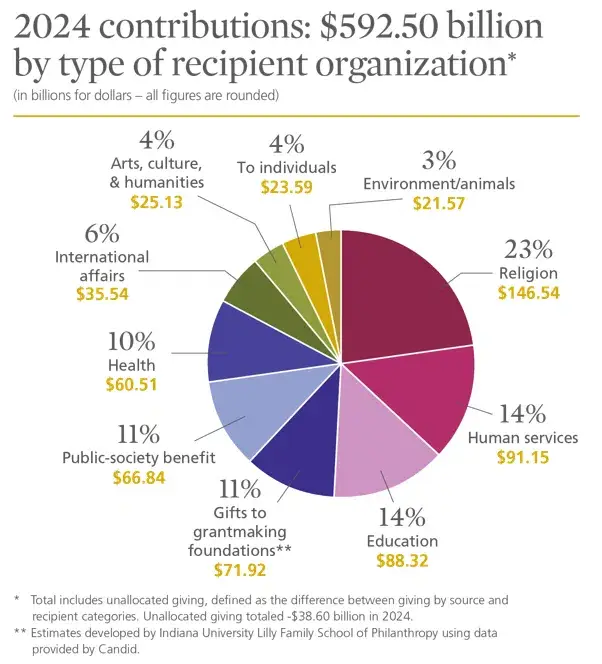
And to get back to the specifics of the conversation with my husband, it wasn’t about the beauty of philanthropy, it was about the realization of where that money went. This is not a criticism of MacKenzie Scott, not at all! Because the breakdown of her donated funds corresponds to the same percentages of all money being donated.
So, in case you are now wondering what percentage of charitable donations go toward climate mitigation, adaptation, and the organizations fighting to keep our heads above water…drum roll please…
The answer is 2%!
Of all the philanthropic money donated to non-profits globally, only approximately 2% is directed toward climate change. Two percent?! Insert crying emoji here!
Think about that. We are sitting on a tree branch, sawing it out from underneath ourselves, and only 2% of our collective generosity is going toward stopping the saw or figuring out how to cushion the inevitable fall. And I am making the leap that this 2% donation rate perfectly mirrors the percentage of daily action we are taking as individuals.
How do we reconcile a country where 69% of people know a crisis is happening, but only 2% of our resources and actions are going toward solving it? It’s not that the 63% of us who are actively worried don’t care. It’s that our entire lives have been engineered around convenience. And, right now, almost everything that is convenient is tethered to fossil fuel consumption. It’s either figuratively (or sometimes literally) wrapped in plastic or fueled by gas.
Choosing the eco-friendly option takes more time, more research, and entirely new choices. When you’re exhausted at the end of a long day, the path of least resistance tends to win. It can feel paralyzing by how hard it is to do the right thing. So, we end up doing nothing new and continue with what is and has become most convenient.
When I look at that 2% number that is how I feel – paralyzed! It is almost impossible to keep writing and maybe unnecessary, because that is what I came here to say, or maybe scream… why are we not doing something? Anything?
Essentially, we need to close the gap between the 69% and the 2%. We have to align what we know with what we do. There is actually a much nicer, more peaceful way to live on the other side of this knowing and doing gap. True peace comes when your daily actions align perfectly with your beliefs.
I know life is busy and overwhelming. I am living that too. I understand that it feels like there is zero space to welcome in anything new, let alone something as heavy as the climate crisis. But, I promise, action is hopeful!
Doing something doesn’t deplete you, it fills you!
If you aren’t sure where to start, no worries, check out my website. I have compiled so many suggestions ranging from the small daily habits to the bigger life changes. If you commit to making life decisions based on your values instead of convenience, you will almost always choose what is right.
If 2% represents where we are today, can we commit to working together to change that math?
It matters! It really does!
- Lake, S. (2026, June 25). MacKenzie Scott alone accounted for one-third of America’s $19.2 billion in megagifts last year | Fortune. Fortune. https://fortune.com/2026/06/25/mackenzie-scott-largest-megadonor-2025-7-billion-donations-giving-usa-iu-report/?utm_source=native_share&utm_medium=mobile&utm_campaign=social_share
- Yale Climate Opinion Maps 2025 – Yale Program on Climate Change Communication. (2026, May 4). Yale Program on Climate Change Communication. https://climatecommunication.yale.edu/visualizations-data/ycom-us/
- Menon, S. (2026b, June 25). Giving to climate change mitigation has doubled since 2020 — but critical gaps persist – ClimateWorks Foundation. ClimateWorks Foundation. https://www.climateworks.org/blog/giving-to-climate-change-mitigation-has-doubled-since-2020-but-critical-gaps-persist/