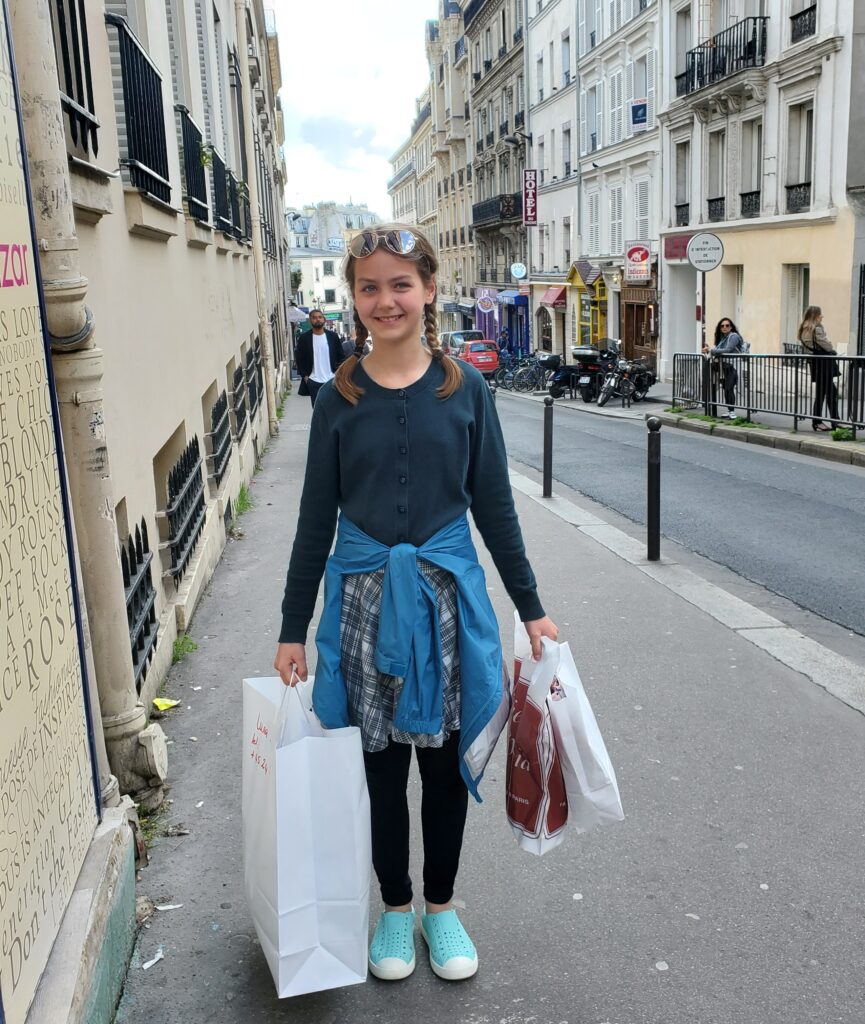
Can you think of a time, any stretch of time, when you didn’t purchase goods or services for yourself or your household? Not a no-spend weekend. Not a busy week where life just got in the way. I mean intentionally choosing not to buy. The reason I ask is that I’m looking closely at the anthropogenic factors driving climate change, and I want to spark conversations about how we can use our power for the good of the planet rather than to its detriment.
Can we buy less shouldn’t feel like a jarring question, but it does, because buying has become our default setting. According to the U.S. Bureau of Economic Analysis, personal consumption expenditures increased by $81.1 billion in January 2026. Even when spending dips in some categories, it rises in others, including food, recreation, and household goods. The machine keeps moving. And while the number is staggering, it’s not surprising. We are living in a culture that craves more and subscribes to the idea that more, bigger, and newer is better.
More convenience. More upgrades. More trends. “Keeping up with the Joneses” is no longer reserved just for your neighborhood, now it has been amplified to a global stage by social media. We measure our lives against people we’ve never met. The result? A constant pressure to consume, driven not by necessity, but by us.
But here’s the thing we all know inherently, all this stuff, this constant “more, more, more,” doesn’t make us happier. In fact, savings rates have dropped dramatically, to just 5% in 2025 compared to 17% in the 1970s. At the same time, financial stress is rising with more than half of Americans reporting that they cannot cover an unexpected $1,000 expense. And still, we buy. So, this isn’t just a climate conversation, it’s a cultural one. It’s not only about a finite planet in an infinite loop, but also about a financial reality that invites a grassroots movement toward zero spending, or as close as possible, with the hopeful outcome of zero waste.
At the heart of this issue is the simple truth that we have all become desensitized to trash. We happily Spring clean our houses, take out our trash every week, and most of us proudly participate in recycling. But the problem that has grown alongside population and consumerism is that we have exceeded the limits of a finite planet.
We live on a finite planet. There is a limit to what Earth can hold, absorb, regenerate, and sustain. In my book, we explain this to kids using boxer puppies as a visual example. “You probably cannot hide a hundred huge boxer puppies in your bedroom because your room has a limit on how many can fit inside. It has a finite amount of space.” Now replace those puppies with furniture, appliances, clothing, electronics, decorations, and all the associated packaging. All the things we buy… and eventually discard. Because here’s the part we’ve become a bit disconnected from, there is no “away.”
When we clean out our homes, take out the trash, or even recycle, where does all that stuff go? I am sure we can all wholeheartedly agree, those items don’t leave the planet. And knowing that our planet is a limited size, not boundless or infinite, we know that more stuff means more waste. We can bury it, we can float it out to sea, we can pile it in a landfill and build a ski slope on top of it, but it is still here. And it is not just taking up space. It’s polluting our air and water, and we aren’t even beginning to address the energy consumption required to create and process all this stuff.
I am trying to say this in a way that cannot be unseen. In my own experiences, understanding helps close the gap between knowing and doing. But seeing it in a way that cannot be unseen helps build action and momentum. Because of course, the problem isn’t just waste. It’s input. We spend a lot of time talking about trash, how to reduce it, recycle it, and manage it better. But what I am really hoping for is, yes of course that, but what if we focused earlier in the process? On the input. Because waste doesn’t start in the trash can. It starts at the point of purchase.
New mattress? The old one goes somewhere. New phone? The previous one becomes waste. New clothes? The old ones are displaced, whether they are worn out or not. We’ve built an entire system around replacement. And rarely do we ask the most important question, what happens at the end of this product’s life?
Rethinking what we actually need comes down to common sense, and I am hoping for a large collective shift in that direction. Because we are trying to sustain a finite planet with a growing population, fueled by limitless consumption, and little consideration for product end-of-life impact. Something in that equation has to change. And the most immediate lever we have is what we choose to buy or not buy.
What if we experimented not with zero waste to start, but zero unnecessary spending, or as close as we can get? Let’s interrupt the cycle and change the entire system. If we can rebuild around the reality of a finite planet, our consumption habits and usage will resemble those of past generations. And by adopting old habits, we actually heal the planet for the future.
We can use what we already have. We can get creative and borrow, share, and repair. We can reduce waste naturally, not because we manage it better, but because we create less of it to begin with. Less, on purpose. We don’t need more. We don’t need newer. We do not need bigger or better or name brand. We just need to remember that we can use what we have and borrow what we don’t. We can repair what breaks, and we can rethink what we’ve been told is normal. Because on a finite planet, less isn’t a limitation, it’s a necessary strategy. This is not an overhaul. It is a redirect. And the result is simple – less can become more.
Schaaf, J. (2026, February 5). Guide to the average savings in America by age | SOFI. SoFi. https://www.sofi.com/learn/content/average-savings-by-age/
US Department of Commerce, BEA, Bureau of Economic Analysis. (n.d.). BEA : BEA Industry Facts. https://apps.bea.gov/industry/factsheet/factsheet.html#33DG
USAFacts. (2025, May 30). Americans aren’t saving as much as they used to. USAFacts. https://usafacts.org/articles/why-arent-americans-saving-as-much-as-they-used-to/