It’s funny how certain ideas snap into focus so suddenly that you can’t imagine how you ever missed them. That’s exactly what happened to me with one of the simplest, most powerful forms of personal climate action – paying attention to the packaging we carry into our homes in our weekly grocery bags. Once I finally saw it clearly, I couldn’t unsee it – and, naturally, I haven’t stopped talking about it since.
Thankfully, my pre–“climate mom” life equipped me with enough social awareness (I hope!) to keep that enthusiasm in the realm of “inspiring” rather than “overwhelming.” My goal has never been to lecture, but rather to spark practical, encouraging conversations about the small shifts in our daily habits that truly add up.
Here’s the core of my thinking:
In the United States, the average person emits roughly 15 metric tons of carbon dioxide each year. There are countless estimates out there, built on complex datasets and methodologies, so for now I hope you’ll take that figure as a reasonable starting point.
That number might look huge, but I don’t think of it that way. My question is always: How do we make that 15 into 14? Or 13? Or 12? And how far can each of us reasonably and comfortably go? Because if I can bring my own footprint from 15 down to 8 – and thousands of others can do the same – then collectively we begin to meaningfully reduce the greenhouse gases entering the atmosphere. You still with me?
Of course, I understand that the ideal path forward includes strong legislation and thoughtful regulation. But those require political will – and we simply cannot afford to wait for that to materialize (if it ever does). Even if our government were already advancing bold, comprehensive climate policy, wouldn’t we still have a responsibility to do our part? If we’d be willing to act alongside good policy later, then we should absolutely be acting without it now. That, in one sentence, captures what motivates me every single day: If we would then, we should now.
Of course, we all live differently.
Some people work from home, grow their own food, and drive electric. Others fly frequently for work, commute long distances, or eat meat with every meal. Most of us fall somewhere in between – a mix of choices that help the planet and choices that don’t.
What I’ve discovered, through countless conversations over the past few years, is that everyone already practices some form of sustainability. Borrowing books instead of buying them, shopping secondhand, maintaining a backyard garden, renting outfits for special events, choosing the train over the plane – these habits show up everywhere, even in households that would never describe themselves as “eco-focused.”
The opportunity isn’t to overhaul our entire lives overnight. It’s to recognize what we’re already doing well and build from there, one simple habit at a time.
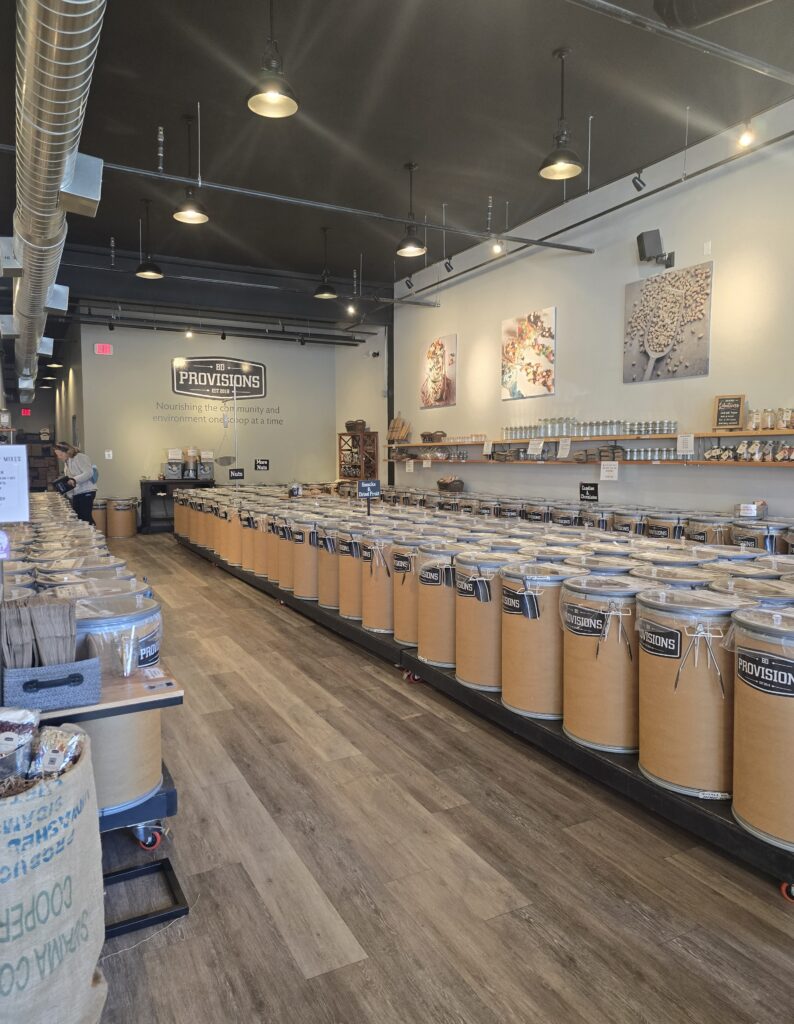
Today, I want to focus on a big (and surprisingly overlooked) household activity that can be upgraded to be far more eco-friendly: shifting from traditional grocery and supply shopping to true bulk, package-free, refillery-style shopping. And to be clear, I don’t mean “bulk” as in buying oversized quantities at big-box stores. I mean shopping from the bins and dispensers in the package-free section of your local market – or at specialty shops designed for refillable, zero-waste purchasing.
Single-use is so much more than plastic!
I have been focused for a while on the elimination of single use items – and it is funny, because every time I say single-use everyone immediately jumps to plastic – plastic bags, plastic utensils, plastic water bottles – but there is so much more that is single-use. One big offender is all of the packaging that is carried into our house each week in our grocery bags. Take a moment to picture your kitchen counter when you unload your weekly groceries. Cardboard boxes holding plastic bags inside. Plastic jugs of milk, laundry detergent, or dish soap. Plastic bottles for shampoo and conditioner. Paper towels wrapped in more plastic. Sponges destined for the trash after a few uses. Even if some of it is technically recyclable, much of it never gets recycled at all – because of contamination, poor design, or simply the realities of our waste systems.
For a finite planet, it’s… well, a lot! And once you start noticing it, it’s hard not to see packaging everywhere: trash bins in public spaces, roadside litter, the constant stream of disposable “stuff” moving through our daily lives.
So, let’s zoom in on one area we can control and meaningfully improve: the grocery run. There are many ways to reduce packaging here. Growing your own food, joining a CSA, or shopping at local farm stores is a fantastic place to start – especially when it comes to avoiding plastic-wrapped produce. But in New England, where I live (and in most four-season climates), those options slow down or pause entirely during the colder months. Which means we need year-round strategies, too.
Enter: bulk and refillery shopping.
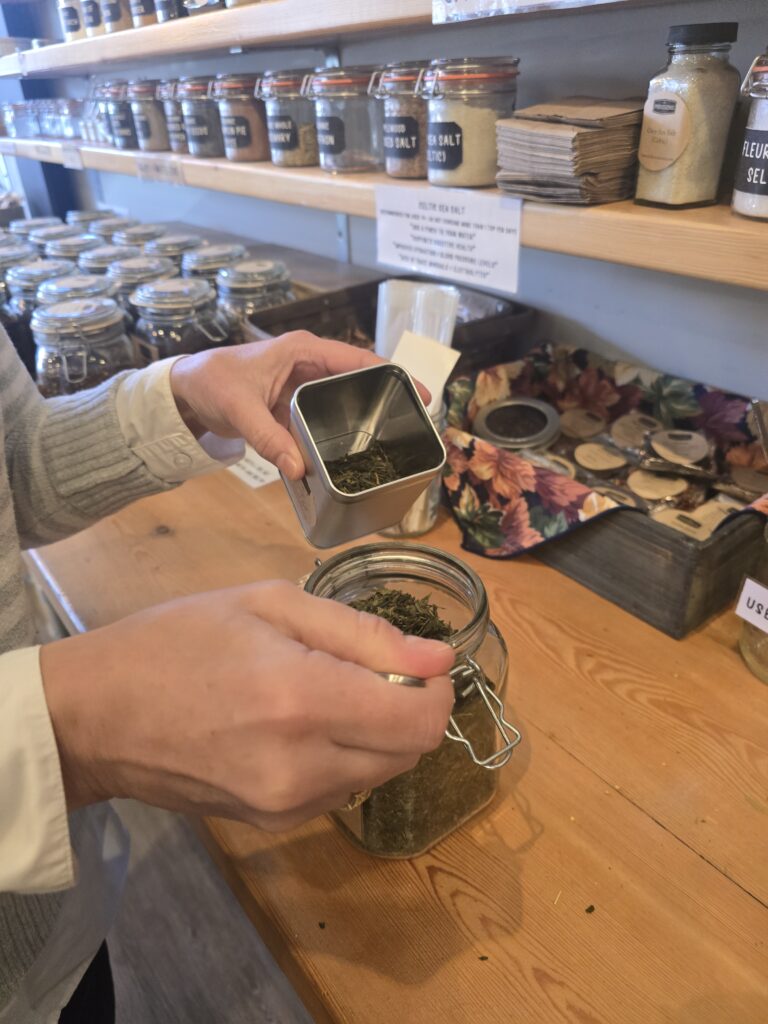
And again, not “bulk” in the big-box sense, where you buy a gallon of everything and hope it fits in the pantry. I’m talking about true bulk and refillery shopping – stores where food, cleaning supplies, and personal-care products are dispensed from large containers and you bring your own jars, bottles, or bags to refill only what you need.
Not every grocery store offers this… which means you may need to add a new stop to your routine. And honestly? I hope you do. There are only a couple of refilleries near me. None are exactly around the corner, but they’re close enough to plan a trip – and well within the range of my electric car – which makes the effort feel not just manageable, but meaningful.
I think the concept of “refill shopping” can be intimidating at first. My local grocery store does have bulk dispensers, yet I rarely see anyone using them. Maybe it’s convenience, but I suspect it’s mostly habit: we’re used to grabbing the prepackaged version, and the idea of weighing, marking, and refilling can feel unfamiliar or confusing.
That’s one of the biggest reasons I love dedicated refillery shops. The ones I frequent are small, locally owned businesses where the owners and staff are genuinely friendly, knowledgeable, and eager to help. They’ll walk you through the entire process and make you feel like a bulk-shopping pro in no time.
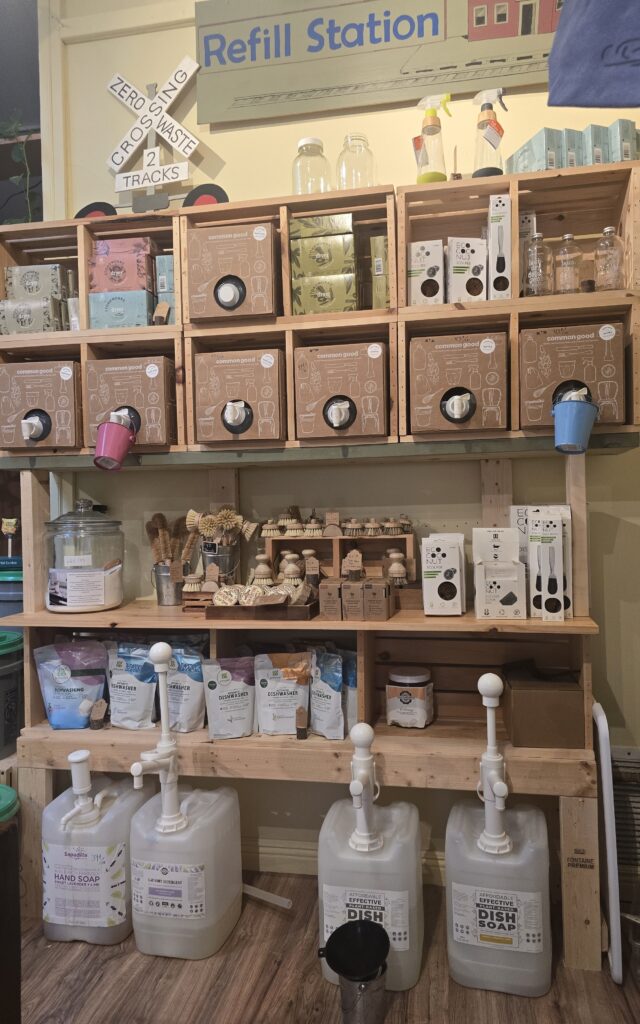
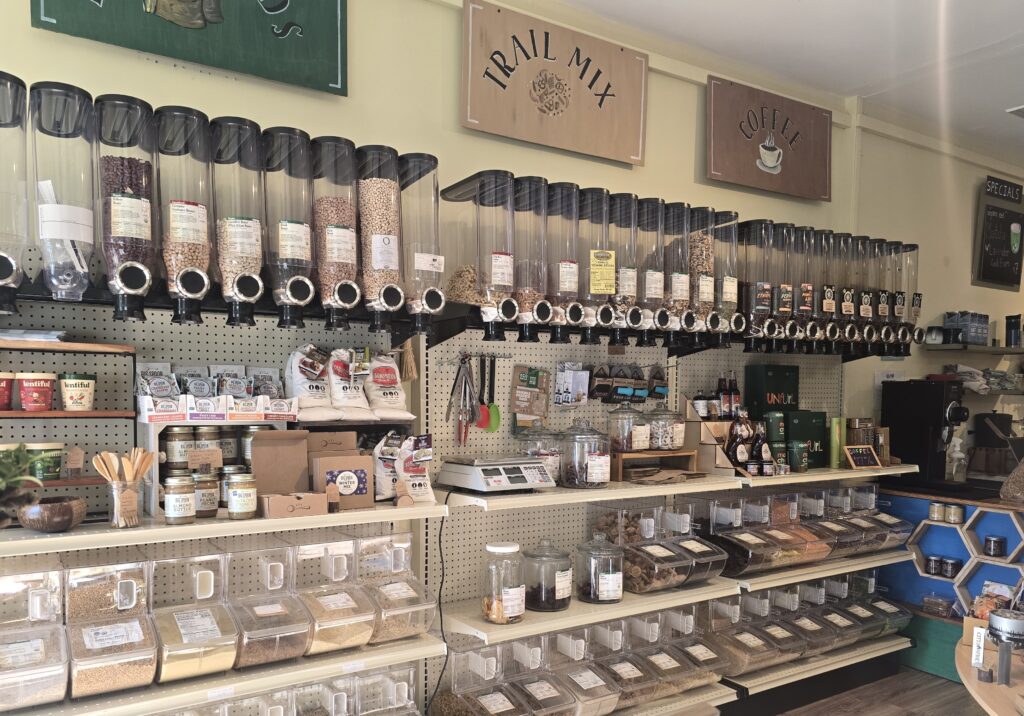
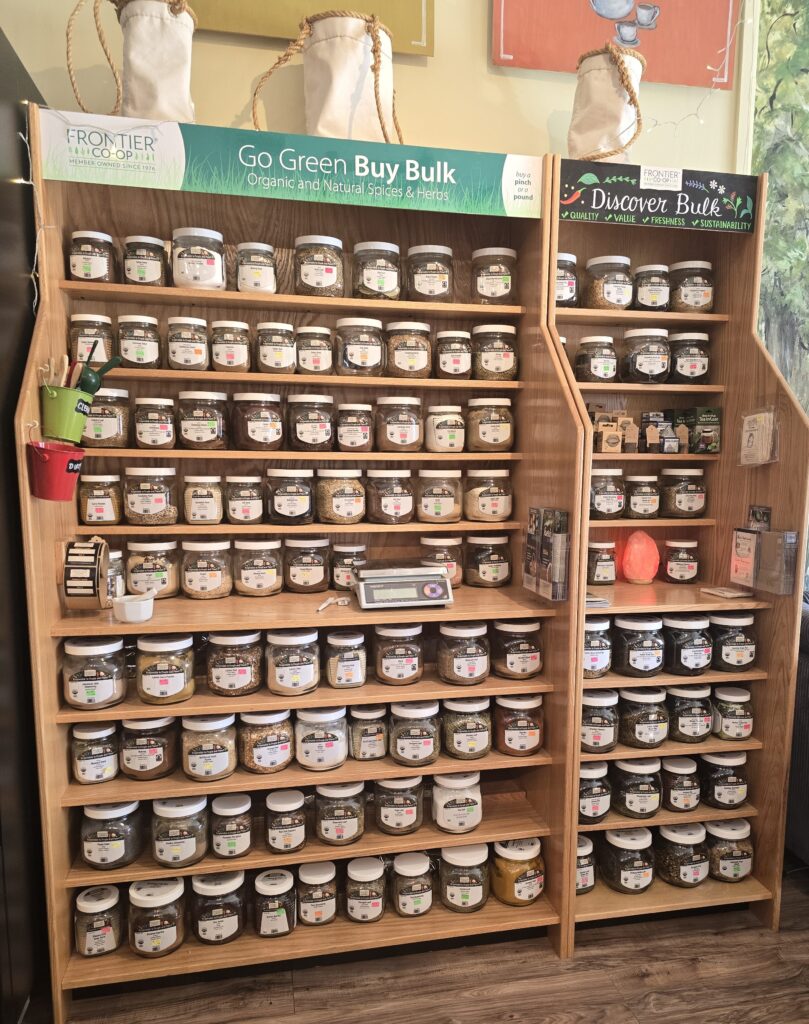
Every store operates a little differently. Some refill your containers for you behind the counter. Others allow self-serve refilling but ask you to exchange your containers for sanitized ones they keep on hand. I’ve seen container-library setups, and stores where you can bring absolutely any jar, bottle, or bag you want. Personally, I like using cloth bags for food items – oatmeal, shredded coconut, sugars, flours, nuts, and canning jars for soaps and detergents.
Are you still with me? I hope so – because this is where the idea becomes truly powerful.
What I’m really asking is simple, but transformative – avoid bringing new disposable containers into your home whenever possible. That’s it. Not perfection – just intention!
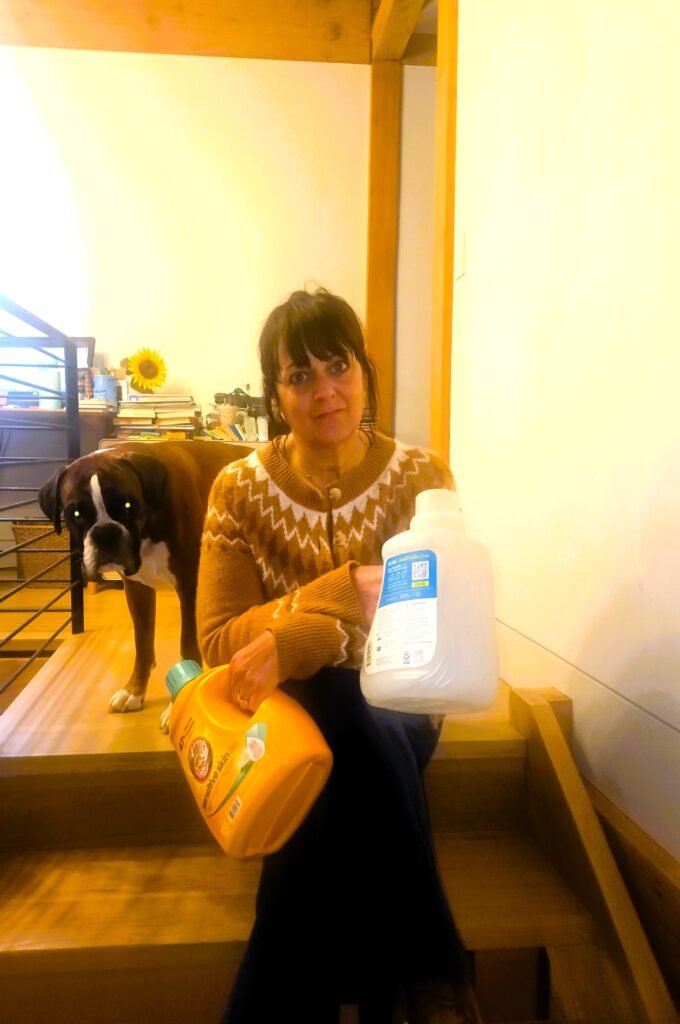
I’ll never forget the moment this clicked for me. I was carrying two enormous laundry detergent bottles downstairs and suddenly thought … Where do these actually end up? And how many of these have I sent out into the world over the years? It was such a stark, unsettling visual. And when you multiply that image by millions of households, the scale becomes almost unimaginable. This isn’t just inconvenient, it’s unsustainable.
But here’s the encouraging part, changing this starts with one decision. If we begin by rethinking our biggest, most common sources of packaging – detergent, soaps, pantry staples – we build the habit. And once that habit is in place, it naturally starts expanding into other areas of our lives.
There are so many ways to support this shift. Becoming an “ingredient household” reduces packaging dramatically. Some companies recycle soft plastics for specific reuse, like creating park benches. And for me, the solution is clear – I refill. I bring my glass canning jar for laundry detergent, I refill my shampoo, conditioner, hand soap, and dish soap, and I buy as many ingredients as I can using cloth bags. The result? My trash and recycling bins stay lighter, and my environmental impact smaller.
So I’ll leave you with this question: Can you do the same?
Even the smallest start makes a difference—and those small starts add up quickly when we all make them. I’d love to hear from you: share your favorite refillery in the comments and tell me which packaging item you’ve proudly stopped bringing home.